
Crypto-native neobanks spent 2025 proving that a stablecoin balance can buy coffee. In late 2026 that's settled, and the interesting question has moved: who actually makes money when the card swipes, and who is just renting someone else's rails and calling it a bank?
The spend data says the category is real but small. Paymentscan tracked roughly $1.12 billion in stablecoin card volume in August, and September month-to-date (around the 22nd) shows RedotPay at $279M, ether.fi Cash at $91M, KAST at $72M, Wirex One at $33M after its mid-month launch, and Plasma One at $17M. Annualize August and you get about $13 billion a year. Set that against McKinsey and QED's estimate in The next age of fintech that only about $390 billion of the headline $35 trillion in annual stablecoin volume is genuine end-user payment activity, and crypto cards are roughly 3% of the real payments layer — and 0.04% of the noise.
So the cards are a wedge, not a business. The business is underneath them, and it comes down to three scarce assets: an owned dollar, an owned license, and owned distribution. Everything else is procurement.
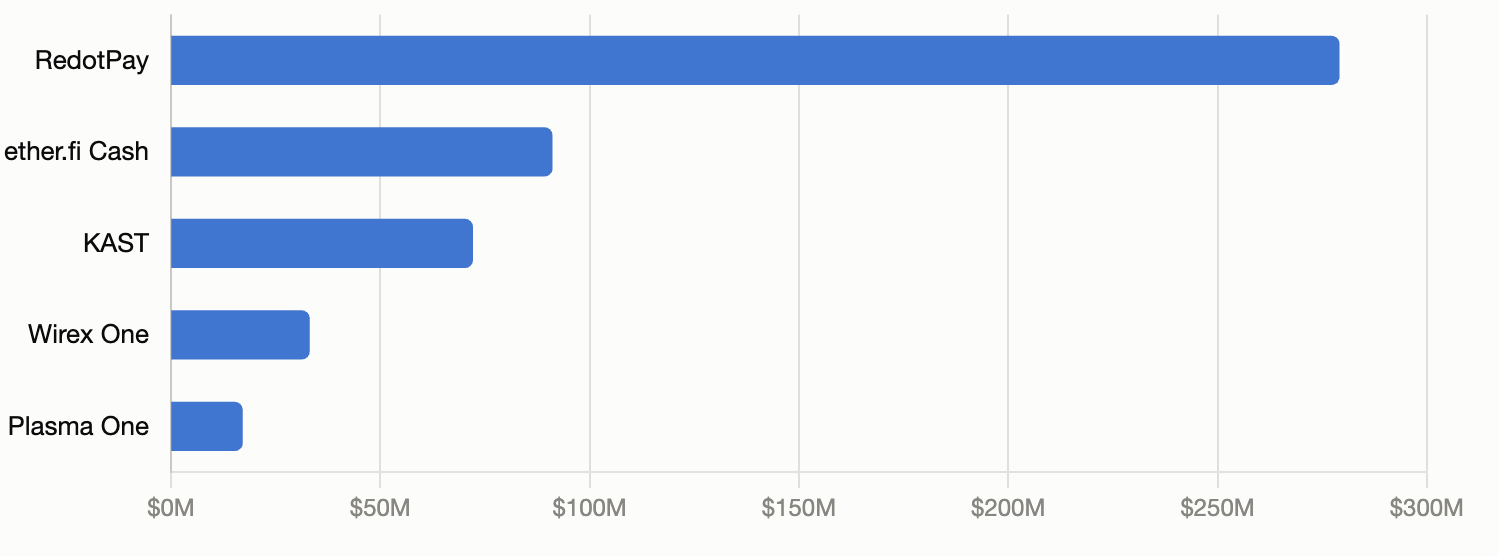
Stablecoin card volume, September 2026 month-to-date (through the 22nd). Source: Paymentscan.
The pyramid is steeper than the narrative
RedotPay alone is about 57% of the tracked top five this month. Ether.fi and KAST are the credible challengers; everyone below them is operating at a scale where a single corridor or a single marketing push moves the ranking. That concentration matters because the sector's pitch — "the consumer layer for stablecoins" — implies a broad market with many viable operators. The data implies one leader, two challengers, and a long tail that has not yet proven it can buy users cheaper than it monetizes them.
The structural picture is better than the volume picture. NeobankBeat's September report counts 381 verified-active neobanks: 261 traditional, 62 hybrid, 58 web3-native. New-neobank formation among survivors collapsed from 43 in 2019 to 11 in 2025, and 32% of the 2020s cohort is self-custodial versus 5% of the 2010s. Fewer launches, structurally different ones.
Where the money actually comes from
Not interchange. Paymentscan's vendor teardown — they deposited and withdrew €5,000 through five leading apps — found the round-trip cost ranged from $2 to over $130 depending on who you used. Same product category, a 60x spread in what it costs you. Full methodology here.
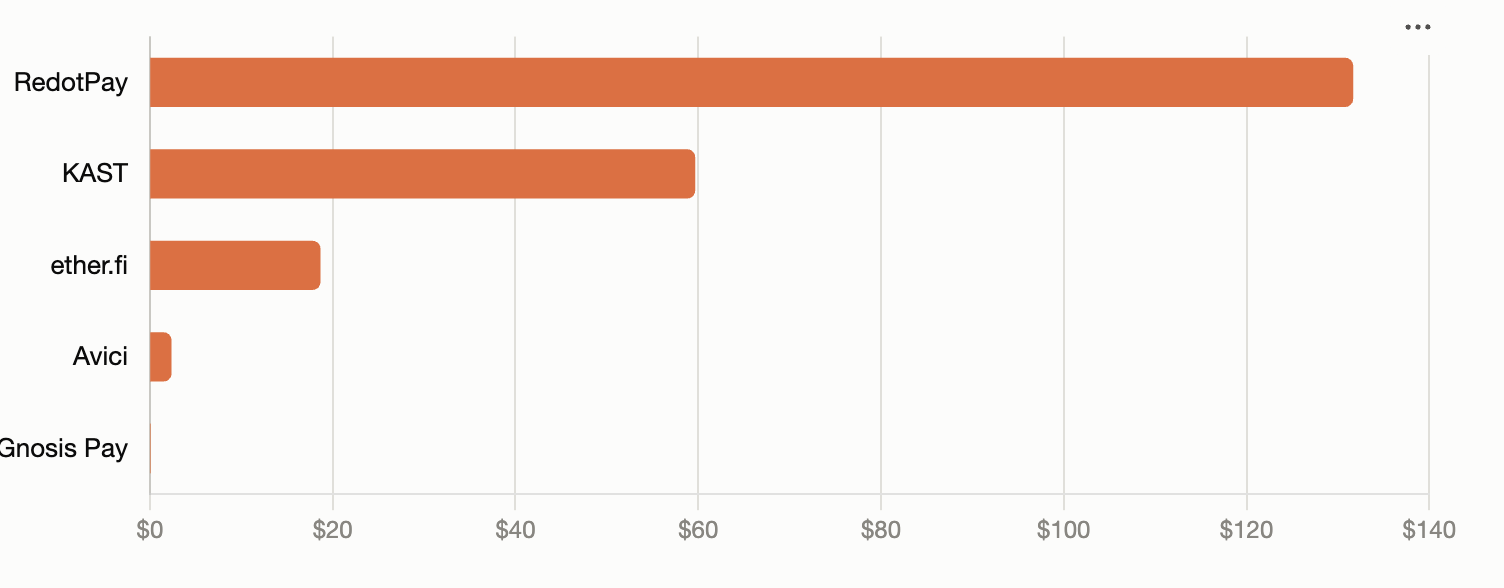
Total cost of a €5,000 deposit and withdrawal round trip, tested July 2026. Source: Paymentscan.
That spread is the P&L. NeobankBeat counts 315 of 381 neobanks issuing a card, 141 advertising cashback and 205 advertising yield — nearly all as "up to" rates gated behind tiers, staking or subscriptions. When an app advertises 4% back and free transfers, the honest question is the one Paymentscan's numbers answer: from what? Usually from FX, sometimes from reserve yield, occasionally from a token nobody has priced properly.
The second thing the teardown exposes is dependency. Most of these apps sit on a short list of vendors — OpenPayd, Bridge, Due, Noah, Iron, Monerium for accounts; Rain, Wirex, Kulipa, Immersve for issuance. Bridge's euro accounts were carrying spreads above 0.5%, which is vendor margin coming out of the neobank's own take. If your product is a skin on shared plumbing, your competitor can ship it in six weeks and your margin is set in someone else's pricing meeting.
Own the dollar or rent it
This is the real dividing line in the September cohort.
Ethena Pay launched September 1 on Avalanche: self-custodial, wrapped around USDe, with roughly 5% standard savings (6% for Pro-VIP, with caps), Visa spend with AVAX cashback, IBANs and fiat on-ramps. Early access opened to a few hundred users; founder Guy Young said mid-month that the US, UK and Europe could open within three to four weeks, with card-partner timelines as the constraint. The point isn't the app. It's that Ethena already owns the yield engine behind the dollar it's distributing.
Wirex One launched September 16 on the Arc L1, positioned toward a private-bank feel and settling in USDC and EURC as a principal Visa and Mastercard member — no intermediary bank taking a cut.
Plasma One, live since June on Plasma's own chain, is the most vertically integrated of the three: zero-fee USDT movement, its own L1, virtual cards via Rain.
Why ownership matters is regulatory, not ideological. Under GENIUS, payment stablecoins can't pay interest in the US. Rewards have to attach to spend, liquidity or product usage — which means the apps that capture reserve yield at the issuer level can fund 5–6% savings and cashback, and the apps merely wrapping someone else's USDC are paying for growth out of equity. McKinsey's framing of the same constraint is worth holding onto: tokenized deposits can pay yield inside the bank perimeter, and JPMorgan's Kinexys is already moving $2–3 billion a day. The incumbent counterpunch isn't a better app. It's programmable money that never leaves the regulated wrapper.
The charter cluster is narrower than the headlines
September delivered a regulatory wave. On the 18th, the OCC conditionally approved three national trust charters: Agora (issuer of AUSD), Bastion (white-label stablecoin, custody, mint/redeem) and Catena, which is explicitly building an AI-native bank for agents. Revolut secured conditional approval for a full US national bank earlier in the month; OpenReserve got a conditional de novo path around tokenized deposits; Block applied for a no-deposit custody trust.
Read the fine print. These are narrow, uninsured trust charters — fiduciary, custody and stablecoin services, not deposit-taking. McKinsey counted 21 US charter applications in 2025, more than the previous four years combined, with approval times down about 40%. That's a window, not a permanent state, and it cuts both ways: a charter removes the partner-bank buffer and replaces it with your own examination cycle, your own capital conditions, and — McKinsey's sharpest point — a possible valuation reset toward bank-like multiples.
The risk this fixes is real, though. Only 35% of NeobankBeat's 381 are licensed banks; 82 run partner-bank models where protection is pass-through and contingent on ledgers staying accurate. That's precisely the joint that failed in Synapse.
The structural migration is the story
Stablecoin support runs at 100% in the web3-native wave and 92% in hybrid — and 2.7%, seven apps, among the 261 traditional players. That asymmetry is the whole strategic picture: capability is table stakes where it's easy and existential where it's hard, because a traditional neobank adding stablecoin rails has to answer custody, licensing, accounting and banking-partner questions a wallet never faces.
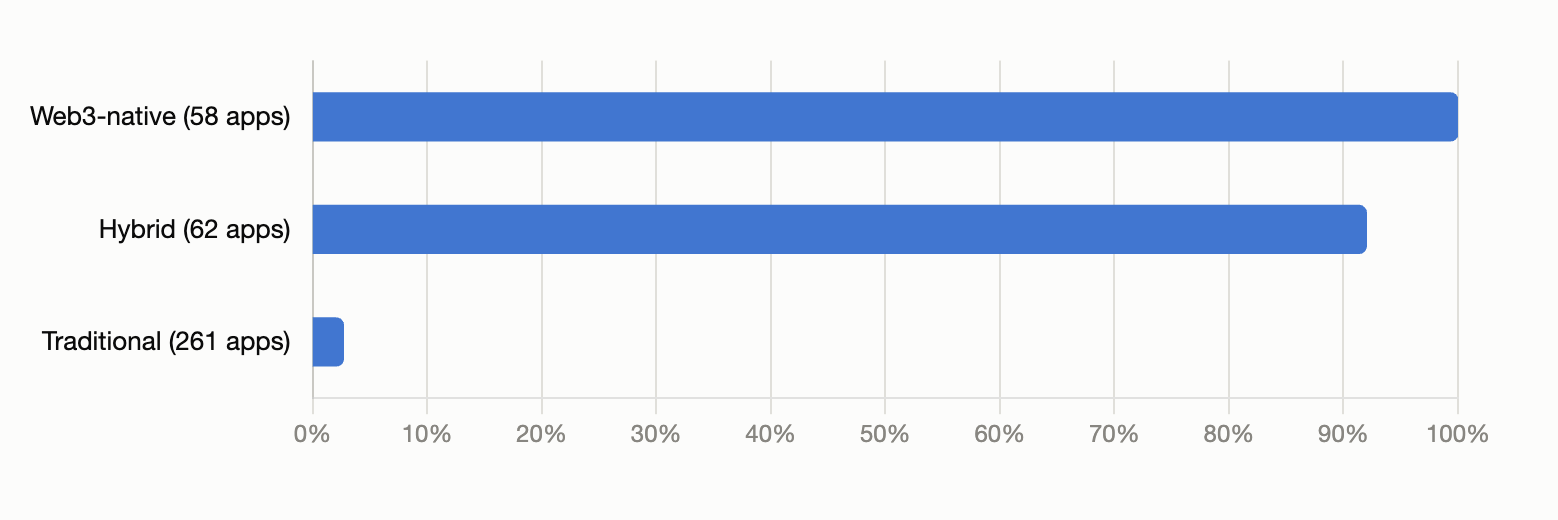
Share of each wave supporting stablecoins, September 2026. The 2.7% sits on top of 261 apps — that's where the users are. Source: NeobankBeat.
What I'd watch into Q4
The 2.7%. One traditional-wave player at Nubank or Revolut scale flipping on stablecoin rails moves more users in a week than the entire web3-native wave has acquired. Track verified launches, not press releases — the announcement-to-live-rails gap is where this migration's real pace shows.
FX spread as the honest fee. Now that someone is testing round-trips with real money, the 2% quietly taken on conversion is a competitive liability. Expect the leaders to compress it and find revenue elsewhere, or expect users to notice.
Whether the US and EU card programs actually ship. Ethena's three-to-four-week timeline is the cleanest public test in the category. Card partners, not chains, are the bottleneck — which tells you where the leverage sits.
Reserve transparency on synthetic dollars. A basis-trade dollar and a T-bill dollar are not the same instrument, and a 6% savings rate funded by the former deserves a different disclosure standard than one funded by the latter.
How the theme gets underwritten. Messari's Onchain Banking work maps the sector through liquid tokens — ETHFI, GNO, XPL, AVICI, JUP, AAVE — rather than equity. That's telling. The public-market expression of "crypto neobank" is still the rails and the yield engines, not the apps sitting on top of them.
My read: the consumer layer is being built, but the durable assets are one level down. Cards are distribution. Licenses are permission. Owned reserve yield is the only thing here that looks like a margin.
Sources
Paymentscan (card volumes, vendor teardown) ·
NeobankBeat, The State of Neobanks №03, September 2026 ·
McKinsey & QED, The next age of fintech, April 2026 ·
Messari, Onchain Banking · Banking Dive (OCC charters) ·
Unchained (Ethena Pay) ·
Crowdfund Insider (Wirex One)