
L2s ver2026: adopt or die
Most L1 tokens still lack a clear mechanism for value accrual — here's how the leading protocols are rethinking thatone of the defining tensions in crypto heading into 2026 is the growing disconnect between network usage and token performance. blockspace has become increasingly commoditized, gas fees have compressed to near-zero across most chains, and the applications generating real revenue on top of these networks have little structural reason to return value to the underlying token.
CoinDesk's State of the Blockchain report quantified this gap clearly — L1 tokens still represent roughly 90% of total crypto market capitalization, but they now capture just 12% of on-chain fees, down from around 60% a year prior. at the same time, six out of eight major ecosystems tracked in the report saw application-layer revenue grow, with NEAR's app revenue rising 190%. the implication is straightforward: economic value is migrating from base layers to applications, and the tokens securing those base layers aren't keeping pace.
this shift has pushed several leading protocols to fundamentally rethink how their tokens interact with the economic activity on their chains. what's emerging is a set of distinct approaches to token engineering — each with different assumptions about where value should be captured and how it should flow back to holders.
the limits of gas fees as a sole value capture mechanism
Sonic Labs published a detailed strategic update in February 2026 that articulated the problem more directly than most L1 teams have been willing to. their vertical integration thesis argues that the traditional L1 economic model — where more users generate more transactions, which burn more gas, which supports the token — no longer holds in a world of abundant, cheap blockspace.
their illustrative case is Polymarket. the prediction platform became one of crypto's most successful consumer applications, brought meaningful retail adoption to Polygon, and yet contributed almost nothing to the value of the MATIC token. it then migrated to its own Polygon CDK chain, with signals that it plans to launch its own token. this isn't an unusual outcome — it's the default when gas fees represent the only economic link between an application and the chain it runs on.
Sonic's analysis puts specific numbers to the leakage. an external DEX generating $2M in annual revenue returns approximately $15K to the chain in gas fees, a capture rate of about 0.75%. the remaining $1.985M exits the ecosystem entirely. across dozens of applications, this adds up quickly and helps explain why L1 tokens trade at dramatically different multiples than the apps built on top of them. according to 1kx's 2025 Onchain Revenue Report, the median price-to-fee ratio for L1 blockchains sits at roughly 7,300x, compared to about 17x for DeFi applications and 8x for lending protocols specifically. the market has, in effect, begun pricing apps as businesses and L1 tokens as something closer to speculative instruments with weak ties to underlying economic activity.
four protocols, four approaches to solving the same problem
the most instructive way to understand where token engineering is heading is to look at how specific protocols have designed their economic mechanisms from the ground up. Curve, Hyperliquid, Jupiter, and Initia each represent a fundamentally different philosophy — commitment locking, vertical integration, revenue recycling, and ecosystem-aligned incentive design — and the tradeoffs between them reveal a great deal about what works, what doesn't, and why.
Curve: commitment locking and the ve-tokenomics flywheel
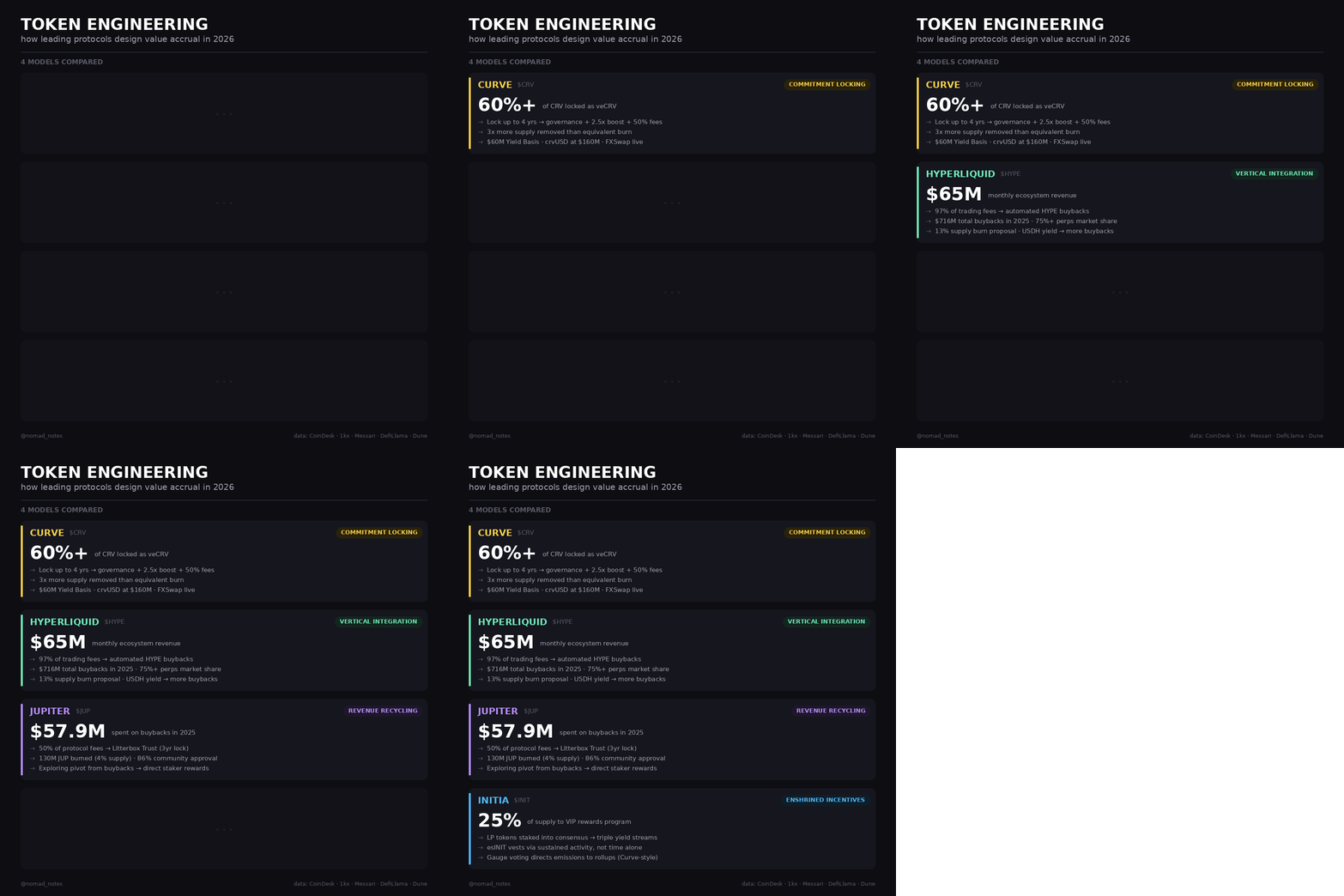
Curve Finance pioneered what remains the most influential governance-linked tokenomics model in DeFi. the core mechanism is veCRV — users lock CRV tokens for up to four years and receive, in return, governance voting power, boosted liquidity provider rewards of up to 2.5x, and a share of 50% of all protocol trading fees. the longer the lock, the more veCRV voting power you receive, creating a direct incentive to commit capital for extended periods rather than speculate on short-term price movements.
over 60% of the total CRV supply is currently locked as veCRV, and Curve's own analysis suggests that this mechanism consistently removes approximately three times more tokens from circulation than an equivalent buyback-and-burn model would achieve. the design is deliberately behavioral — it makes long-term holding more economically rational than selling, and it turns governance participation into a yield-generating activity rather than an abstract right.
this dynamic created what the industry now calls the "Curve Wars," where external protocols — most notably Convex Finance — compete aggressively to accumulate veCRV voting power in order to direct CRV emissions toward their preferred liquidity pools. Convex alone controls a substantial share of all veCRV, and the bribery markets that have formed around gauge voting represent an entirely new layer of DeFi economics that didn't exist before Curve's model proved viable.
the protocol is now extending this framework into new revenue verticals. a $60 million Yield Basis Protocol is designed to generate income for veCRV holders through BTC-collateralized pools, with 35–65% of yields flowing to stakers. crvUSD, Curve's native stablecoin, has reached approximately $160 million in circulation and generates revenue through its LLAMMA soft-liquidation mechanism. and FXSwap, which uses a hybrid StableSwap-CryptoSwap model, is targeting the $7.5 trillion daily forex market. Curve also recently activated a fee switch that distributes protocol fees as crvUSD rather than ETH, reinforcing the stablecoin's utility within the ecosystem. the 2026 development roadmap, funded through a proposed 17.45 million CRV grant to Swiss Stake AG, includes Llamalend V2 and Curve-Lite deployments across new EVM chains.
the strength of the ve-model lies in its self-reinforcing nature: locked tokens reduce sell pressure, governance participation generates yield, and the competition for voting power creates organic demand for the token that is largely independent of broader market sentiment. the weakness is complexity — the system demands significant user sophistication, and the four-year lock requirement can deter participants who are unwilling to commit capital for that duration.
Hyperliquid: the chain as the product
Hyperliquid represents the most aggressive form of vertical integration in crypto — the perpetual futures exchange and the L1 blockchain are architecturally inseparable, meaning every trade, liquidation, and fee on the platform directly strengthens the HYPE token because there is no separation between application and infrastructure.
the economic results reflect this design choice. as of January 2026, the protocol generates approximately $65 million per month in ecosystem revenue, with 97% of all trading fees routed to automated HYPE buybacks via the Assistance Fund. total buybacks across 2025 reached $716 million — the largest buyback program in crypto — and the fund was executing approximately $1.7 million in weekly repurchases as of early 2026, with volume accelerating 26% week-over-week during periods of elevated activity. the protocol processed over $200 billion in monthly trading volume in early 2026 and captured more than 75% of the decentralized perpetuals market according to Artemis' valuation analysis.
what makes this model distinctive is the absence of external dilution. Hyperliquid never raised external financing, meaning zero tokens were allocated to venture investors. the initial distribution allocated 31% to early users via airdrop, 38.888% to future community emissions, and 23.8% to core contributors with a one-year lock. the result is that the buyback mechanism operates against a clean supply structure — purchased tokens represent genuine demand rather than a mechanism for offsetting investor unlock pressure.
the protocol is now deepening its value accrual through several parallel initiatives. a governance proposal to burn roughly 13% of circulating supply — potentially over $1 billion in HYPE — from the Assistance Fund is under community discussion. USDH, their MiCA-compliant native stablecoin, channels 95% of reserve yield into further HYPE buybacks, creating a reinforcing loop between stablecoin adoption and token demand. the HyperEVM launch is expanding Hyperliquid from a singular trading platform into a general-purpose L1, with over 175 teams building on the ecosystem as of mid-2025. and the HIP-3 upgrade enabled permissionless perpetual market creation, requiring a 1 million HYPE stake to deploy a new market — adding a significant new demand sink for the token.
the risk profile is concentrated: if trading volume declines materially, the entire buyback mechanism weakens. but the model demonstrates that when a chain's economic activity and token value are structurally fused, the flywheel between usage, revenue, and token appreciation can be remarkably powerful.
Jupiter: buybacks, burns, and the tension between growth and accrual
Jupiter's approach to token engineering illustrates both the potential and the limitations of revenue-funded buybacks when applied to a high-growth aggregator model. as Solana's dominant DEX aggregator, Jupiter generates substantial fee revenue across its spot and perpetual futures products. beginning in February 2025, the protocol committed 50% of all protocol fees to buying JUP tokens on the open market, with purchased tokens locked in a third-party reserve called the Litterbox Trust for a minimum of three years.
the initial buyback was notable — 4.88 million JUP acquired at an average price of $0.683 for a total of $3.33 million. on an annualized basis, with Jupiter's 2024 revenue projected at approximately $102 million, the implied buyback volume could exceed $50 million per year, placing it among the larger buyback programs in DeFi. by September 2025, the Litterbox Trust had accumulated roughly 95.9 million JUP tokens, and the total buyback spend across 2025 reached approximately $57.9 million.
however, the program's impact on token price has been limited. JUP trades approximately 89% below its all-time high of $1.83 as of late 2025, despite the platform's revenue growth and the buyback's consistent execution. the primary headwinds are structural: monthly team and insider unlocks of approximately 53 million JUP (around $11.7 million at recent prices) continued through the first half of 2026, effectively offsetting a large portion of the buyback's absorption. the annual Jupuary airdrop, while reduced from 700 million to 200 million tokens in the latest round, adds further sell pressure.
recognizing the limits of passive accumulation, Jupiter's community voted in November 2025 to burn 130 million JUP from the Litterbox Trust — approximately 4% of circulating supply — with 86% approval. this marked a shift from the original "buy and hold" model toward a more aggressive deflationary approach. the DAO also suspended all governance voting until 2026 to reset the process, and began exploring the possibility of redirecting 50% of protocol fees toward staker rewards rather than buybacks, which would represent a fundamental pivot from supply reduction to direct yield distribution. critics like Siong Ong have questioned whether the $70 million spent on buybacks in 2025 would have been better allocated to user acquisition and ecosystem development.
Jupiter's case is instructive because it demonstrates that buybacks alone are insufficient if they exist alongside aggressive emissions schedules. the tension between growth-stage token distribution and value accrual is real, and the protocol's evolution — from buyback accumulation to burns to potential staker rewards — shows a team iterating in real time on the question of how to make a governance token behave more like a productive asset.
Initia: enshrined liquidity and the VIP incentive architecture
Initia takes a fundamentally different approach to tokenomics by attempting to solve the value accrual problem at the architectural level rather than through post-hoc mechanisms like buybacks or fee switches. the protocol is a Cosmos-based L1 designed to coordinate a network of application-specific rollups called Minitias, and its economic model is built around two interlocking mechanisms: Enshrined Liquidity and the Vested Interest Program (VIP).
Enshrined Liquidity replaces traditional proof-of-stake with a system where users can stake INIT-paired LP tokens from the native InitiaDEX directly into the consensus mechanism. this means a user providing liquidity to, say, an INIT-USDC pool can simultaneously earn swap fees from DEX trading, staking rewards from block production, and governance voting power — eliminating the traditional tradeoff between staking and liquidity provision that plagues most PoS chains. every whitelisted LP pair must include INIT, which creates a network of trading routes all flowing through the native token and ensures that deeper ecosystem liquidity is structurally tied to INIT demand. getting a new token pair whitelisted requires governance approval, which means rollups seeking deep liquidity must either accumulate voting power or court existing voters — a game-theoretic design that echoes Curve's gauge wars but operates at the chain infrastructure level rather than the application level.
the VIP is the protocol's primary incentive distribution system, commanding 25% of the total 1 billion INIT supply. rewards are distributed as esINIT — escrowed, non-transferable tokens that vest over time based on continued user activity. each participating rollup defines its own scoring criteria (trading volume, liquidity provision, NFT minting, game achievements, or other on-chain actions), and users must maintain their activity score across multiple epochs to fully unlock their rewards. this is a deliberate departure from the airdrop-and-dump model — you don't get rewarded for showing up once; you get rewarded for sustained, measurable contribution.
the allocation of VIP rewards across rollups is governed by a dual-pool system with gauge voting. the Balance Pool distributes rewards proportionally based on how much INIT value has been bridged to each rollup, while the Weight Pool distributes based on gauge weights determined through staker voting — directly inspired by Curve's model. INIT and Enshrined Liquidity stakers vote to direct emissions toward their preferred rollups, creating a competitive dynamic where rollup teams must attract voting support to receive their share of protocol incentives. protocols like Cabal have already emerged as meta-governance layers, aggregating voting power and enabling rollups to bribe depositors for favorable gauge allocations — replicating the Convex-Curve dynamic at the ecosystem coordination layer.
what distinguishes Initia's approach is the attempt to make the tokenomics inseparable from the infrastructure itself. rather than adding buybacks or fee switches after the fact, the economic model is designed so that every major activity in the ecosystem — staking, providing liquidity, using applications, governing reward distribution — requires INIT and reinforces its utility. the initial circulating supply at launch was approximately 14.88%, with team and investor tokens subject to a 4-year vesting schedule including a 1-year lock, and investor dilution held to 15.25% — notably lower than many comparable L1 launches. the project raised approximately $25 million across three rounds from investors including YZi Labs, Delphi Ventures, and Hack VC. as of mainnet launch in April 2025, 18 rollup teams were building on Initia, with 9 already live.
the model's risk lies in its complexity. users need to understand escrowed tokens, vesting schedules, gauge voting, LP staking mechanics, and rollup-specific scoring criteria to fully participate — a significant barrier to adoption relative to simpler designs. but if the thesis holds that sustainable tokenomics requires embedding value accrual into the chain's core architecture rather than bolting it on later, Initia represents one of the most ambitious attempts to prove that thesis in practice.
the broader picture: what these models reveal
looking across Curve, Hyperliquid, Jupiter, and Initia, the common thread is a rejection of passive tokenomics — the idea that a token can derive value simply from being the gas asset or governance instrument of a growing network. each protocol has concluded, through different reasoning and at different points in its development, that token value must be actively engineered through mechanisms that create structural demand, reduce circulating supply, or tie the token's utility to specific economic activities that cannot easily be replicated elsewhere.
Vitalik acknowledged this broader dynamic in February 2026 when he stated that L2s can no longer function as "branded shards" of Ethereum and need to identify unique sources of value beyond cheap transactions. Messari's Crypto Theses 2026 frames the challenge in even broader terms: despite a growing number of cash-rich protocols, the inability to link protocol earnings to tokenholders has prevented altcoins from establishing a fundamental margin of safety. and Pine Analytics' research on L1 value capture compression demonstrates that the market is actively building tools — from prop AMMs to cross-chain order flow routing — that systematically erode the fee revenue L1s once took for granted.
the DeFi protocols that are addressing this — Hyperliquid generating $65 million monthly in holder revenue, Curve locking over 60% of its supply for years at a time, Jupiter iterating from buybacks toward direct staker rewards, Initia embedding gauge-directed incentives into the chain's consensus layer — are collectively building toward something that increasingly resembles traditional equity-like value accrual, adapted for decentralized systems.
the rest of the market is still selling blockspace into an environment that has far too much of it. and the gap between these two groups is widening.
sources & further reading:

CoinDesk — State of the Blockchain 2025
1kx — 2025 Onchain Revenue Report
Pine Analytics — The Compression of L1 Value Capture
Messari — The Crypto Theses 2026
Messari — The Bear Case for Token Buybacks
Sonic Labs — Vertical Integration: The Missing Link in L1 Value Creation
Sonic Labs — Sonic in 2026 and Beyond
Curve Finance — Beyond Burn: Why veCRV Unlocks Sustainable Tokenomics
Curve — CRV Token Overview & Tokenomics
Tokenomics.com — Hyperliquid: How HYPE Captures $65M Monthly
Artemis — Hyperliquid: A Valuation Model and Bull Case
Collective Shift — HYPE Deep Dive
ASXN — HYPE Buybacks Dashboard
CoinDesk — Jupiter's Buyback Plan Sparks Solana Dominance Concerns
Jupiter Community — Litterbox Burn Vote
Bokiko — Jupiter's Paradox: A Profitable Platform, an Underperforming Token
Initia Docs — Tokenomics
Initia Docs — Enshrined Liquidity and Staking
Initia Docs — VIP Gauge Voting
Gate.io — Initia's Enshrined Liquidity Explained
DAIC Capital — Initia VIP Program Guide
DSRV — Initia's Interwoven Economy in a Nutshell
Four Pillars — Initia: What If We Rebuild Ethereum for the Rollups?
DWF Labs — Token Buybacks in Web3: Trends, Strategies, and Impact
BlockBeats — DeFi's Comeback Secret Weapon: Buyback, Fee Switch, and Dividend Future Vision
Vitalik Buterin — L2s and Their Role in Ethereum (Feb 2026)
Blockworks — Solana Financials Dashboard
DefiLlama — Protocol Revenue Rankings
DefiLlama — Protocol Fees Rankings
Dune Digest 041 — Uniswap Fee Switch & UNI Burn