
Deal Memo: The Float War, Crypto Neobanks vs. Fintechs
Infrastructure Alpha · Sector thesis memo · November 24, 2026
Executive summary
The crypto neobank race is a fight over idle balances, not card swipes. We'd back licensed distribution in dollar-scarce markets and the risk layer under onchain yield. We'd pass on cashback-funded card front-ends and on undifferentiated issuing plumbing at current prices.
Stablecoin card spend hit $1.116B in August 2026, roughly 7x December 2024. The headline hides thin card economics. In Q2 2026, ether.fi Cash paid out $5.83M in cashback against $3.34M in card fees and borrow interest. The swipe is the customer acquisition cost. The prize is the balance that never gets swiped.
The math is simple. At Circle's 3.5% reserve return, $1B of idle balance earns about $35M a year. $1B of card spend at ether.fi's estimated 1.38% take earns $13.8M. Float is worth roughly 2.5x the swipe, every year the money sits.
Traditional finance now wants the same balance. SoFi put SoFiUSD in front of 14.7M members, PayPal pays 4% rewards on PYUSD, JPMorgan's deposit token is live on Ethereum, and 21 institutions target a joint dollar stablecoin in H1 2027. The rails are converging. Licences and distribution decide who keeps the spread.
Market: real volume, thinner than the headline
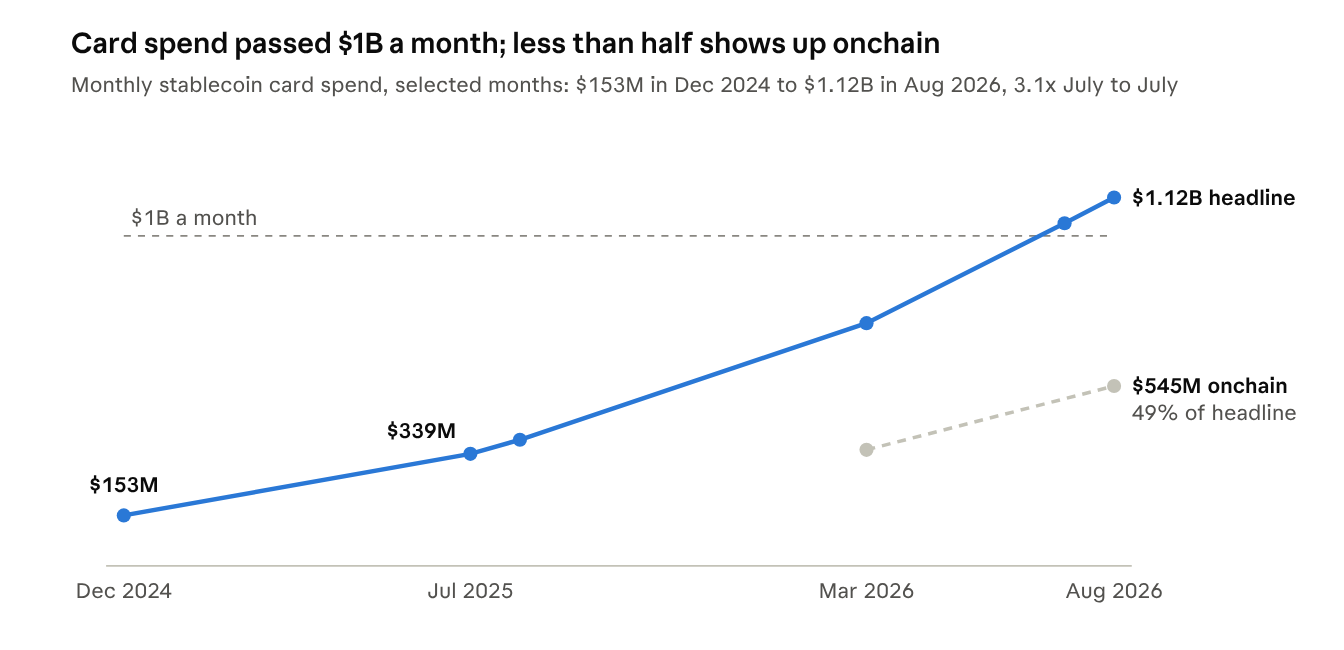
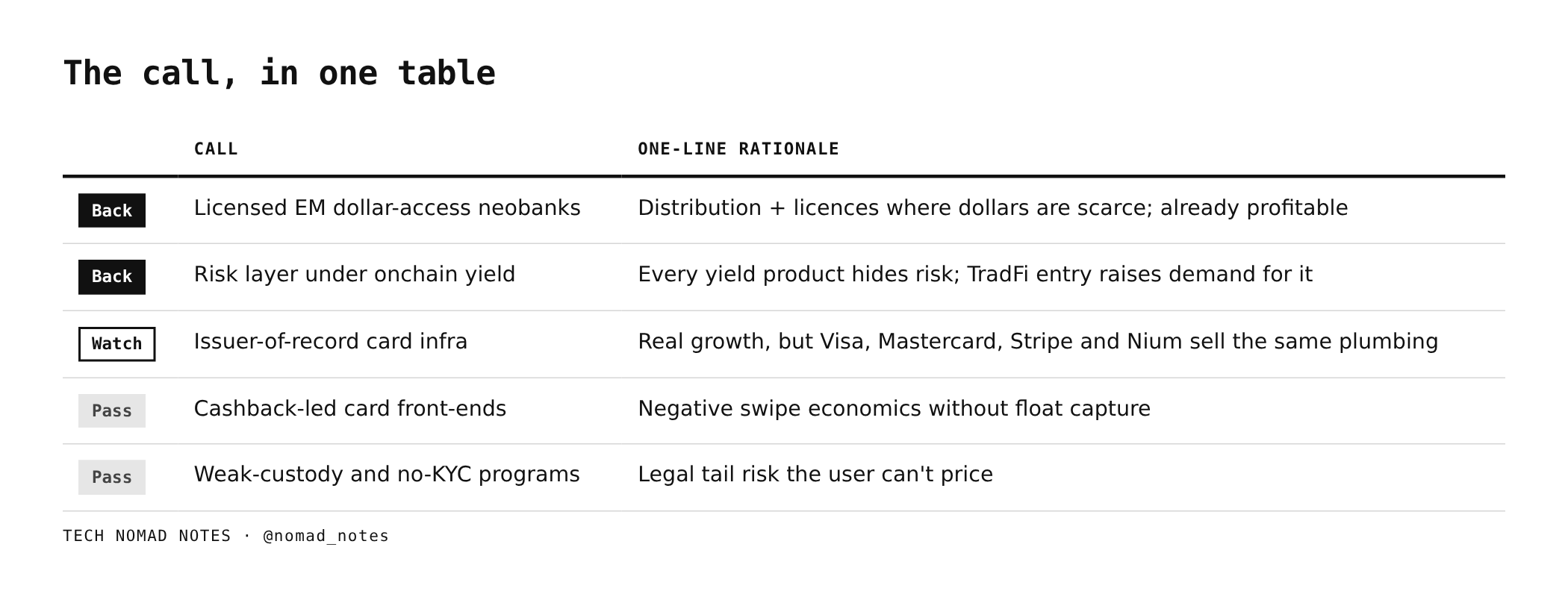
Monthly stablecoin card spend, selected months. Source: Paymentscan via Defiprime (Sep 10, 2026), crypto.news, CoinGabbar. March 2026 headline as restated; March onchain value backed out from Defiprime's "up 55% since March"; onchain line excludes RedotPay's self-reported spend.
Stablecoin card spend is real and compounding. More than 10 million purchases ran through these cards in July 2026, and USDC and USDT funded over 70% of them. ether.fi Cash's nearly 10M transactions are mostly under $100. That's top-of-wallet use, not speculation.
The caveat sits in the gap on the right of the chart. Paymentscan restated March 2026 from $607M to $735.3M after adding ten programs and swapping RedotPay's onchain top-ups for RedotPay's own spend figure. Part of the headline growth is coverage growth. For underwriting, use the onchain line.
Investment thesis: three claims
1. The float beats the swipe
Card revenue is a rounding error next to balance revenue. DefiLlama's adapter for ether.fi Cash estimates revenue at 1.38% of spend, before costs. Then cashback eats it: in Q2 2026, Cash earned about $3.14M in transaction fees and $0.2M in Aave borrow interest, and paid out $5.83M in cashback. That's roughly –$2.5M on the swipe before a single salary.
The balance is different. Circle earned $658M of reserve income in Q3 2026 at a 3.5% reserve return. Apply that rate to $1B of parked dollars and you get ~$35M a year, about 2.5x what $1B of annual spend earns at 1.38%. Users are already parking: cumulative card top-ups reached $13.8B by August against $11.61B of cumulative spend. The two figures come from different trackers, so treat the ~$2.2B gap as a signal, not a balance sheet.
Nubank makes the point for us. It lists float as one of its three revenue sources, next to credit and fees, on $47.5B of deposits that cost it 87% of the interbank rate. A neobank that owns the balance owns the margin.
2. The rails are commoditizing
Every layer between the user's dollar and the merchant now has a well-funded seller. Rain issues as a Visa principal member for 200+ partners. Nium launched a stablecoin card platform on Visa and Mastercard in March 2026. Mastercard closed its BVNK acquisition on August 3. Stripe owns Bridge. Visa's stablecoin settlement passed a $25B run rate, 10x year over year.
The yield layer is going the same way. Aave Labs opened Stable Vaults to any business on July 9, letting a wallet or neobank show a fixed savings rate without running a DeFi desk. Morpho powers Coinbase's USDC lending with $500M+ in deposits and $1.4B+ in active loans. When Visa, Mastercard, Stripe and Aave all sell the same plumbing, plumbing margins compress.
3. Licences and distribution are the moat
What's left to own is the customer and the permission to serve them. RedotPay shows the shape: 9M+ customers and operating margins above 50%, with web traffic led by Bangladesh, India, Egypt and Nigeria, and the US at 4%. Demand comes from people who can't get a dollar account, not from Americans swapping debit cards.
The capital is following that read. KAST earmarked its Series A for hiring, licensing applications and product. RedotPay's Series B went to acquisitions, licences and compliance. Revolut's $115B mark landed the same week it got the first full Australian banking licence ever issued to a global fintech. Licences are the expensive, slow, non-forkable part of the stack.
Landscape: two camps, one balance
"Neobank" now covers two very different animals. Crypto-native apps start onchain and bolt on card rails. Fintechs and banks start with a licence and bolt on stablecoins. The custody column is where they really split.
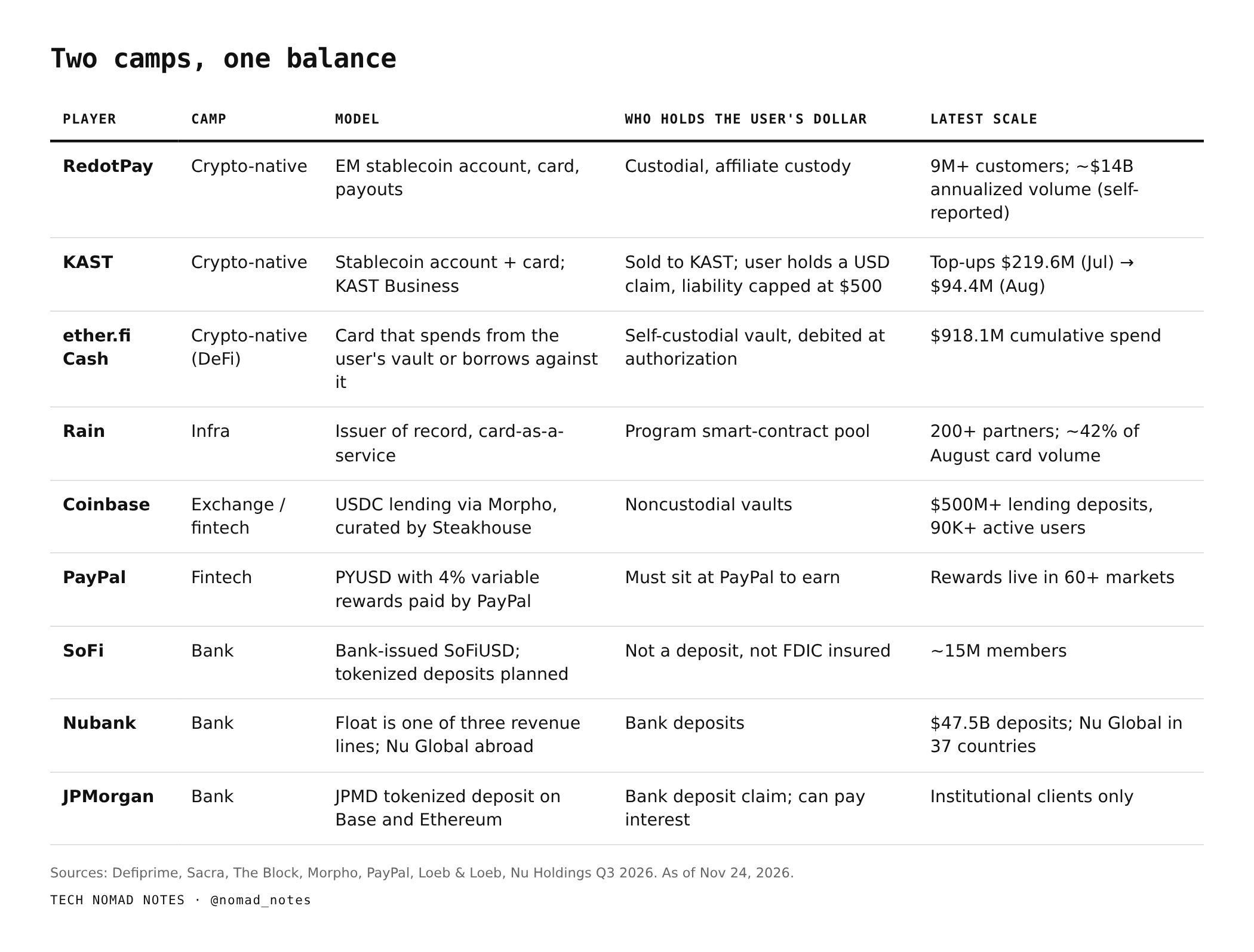
Custody is messier than self-custody vs bank. Of 18 card programs Defiprime reviewed, only eight are self-custodial. KAST's terms went through three versions in a year, from third-party custody to treating deposits as a sale, contracted through an entity in Anjouan, Comoros. Even SoFiUSD, issued by a national bank, is not a deposit and not FDIC insured. The only onchain dollar that keeps a bank claim is the tokenized deposit, and today JPMorgan's JPMD is institutional-only.
For an investor, this column is the liability. The same $10,000 balance can be an insured deposit, a claim on a bankruptcy estate, or a $500-capped promise. Users don't price that difference until something breaks.
Comparable rounds and what they price in
Crypto-native neobanks are priced between Nubank and Revolut, without Revolut's licence stack. The multiples below divide the last mark by the revenue figure each company or its trackers put next to it, so the bases differ. Read them as orders of magnitude.
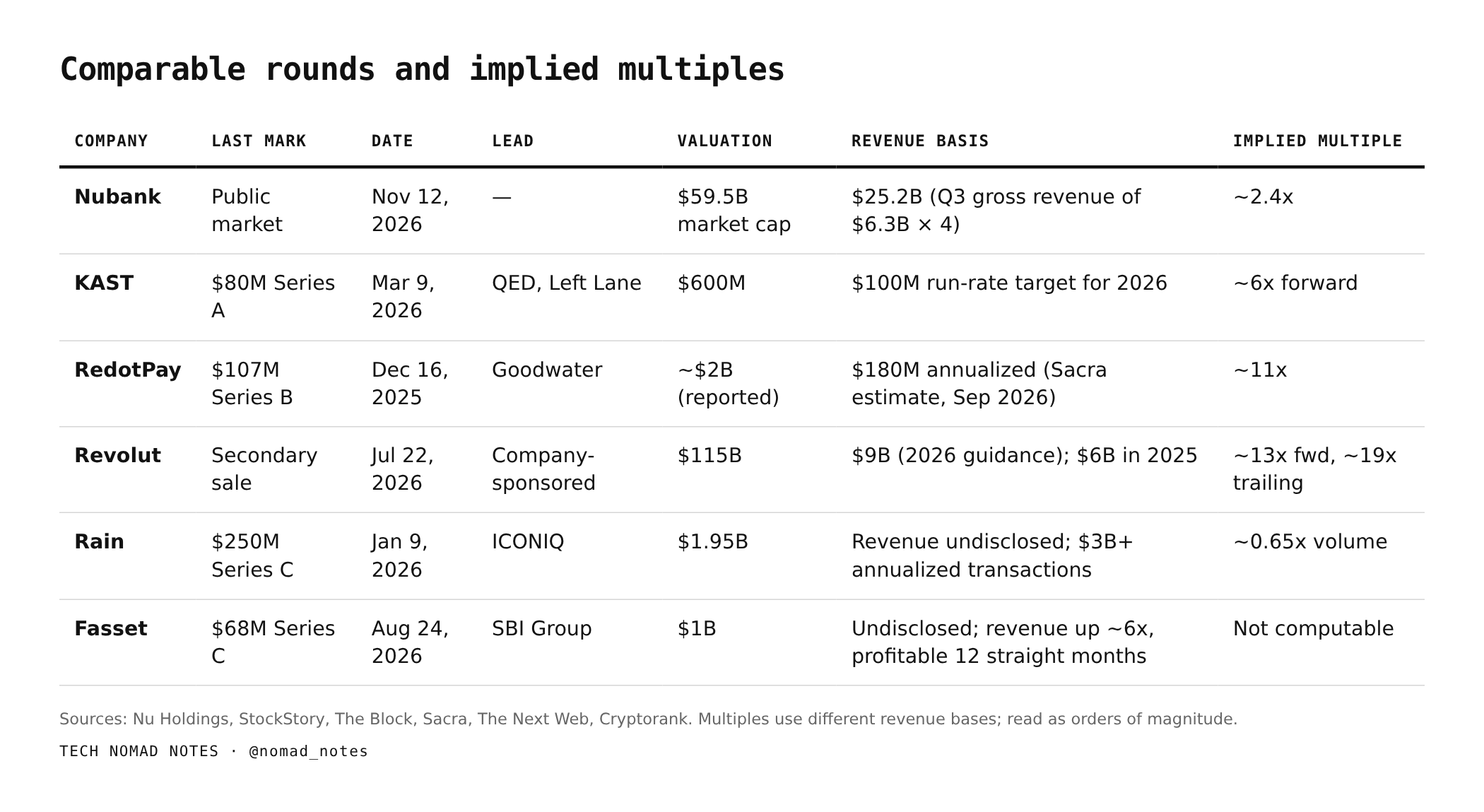
Three reads from the table:
RedotPay is priced like Revolut, on a fraction of the moat. ~11x run-rate is a Revolut forward multiple. Revolut earned $2.3B pre-tax in 2025 across banking licences on several continents. RedotPay is profitable too, but its spend figure is self-reported and its users sit in markets where licensing is still in motion. The reported $4B+ IPO target would take it past 20x.
KAST's 6x is cheap only if the target holds. The company claims 15–20% monthly growth. Onchain top-ups fell from $219.6M in July to $94.4M in August, while settlement to Rain rose from $89.6M to $104.8M. That's a cooling inflow, not a growing float.
Rain is the infrastructure bet, priced for it. Its valuation rose 17x in 10 months, and settlement through Rain is ~42% of tracked card volume. That's a concentration premium, and concentration is exactly what Nium, BVNK and Bridge are funded to break.
Value capture: who earns the interest on idle balances
Five layers claim the same yield, and distribution sets the split. The issuer layer is the fattest, but it already pays most of its revenue out to whoever owns the customer.
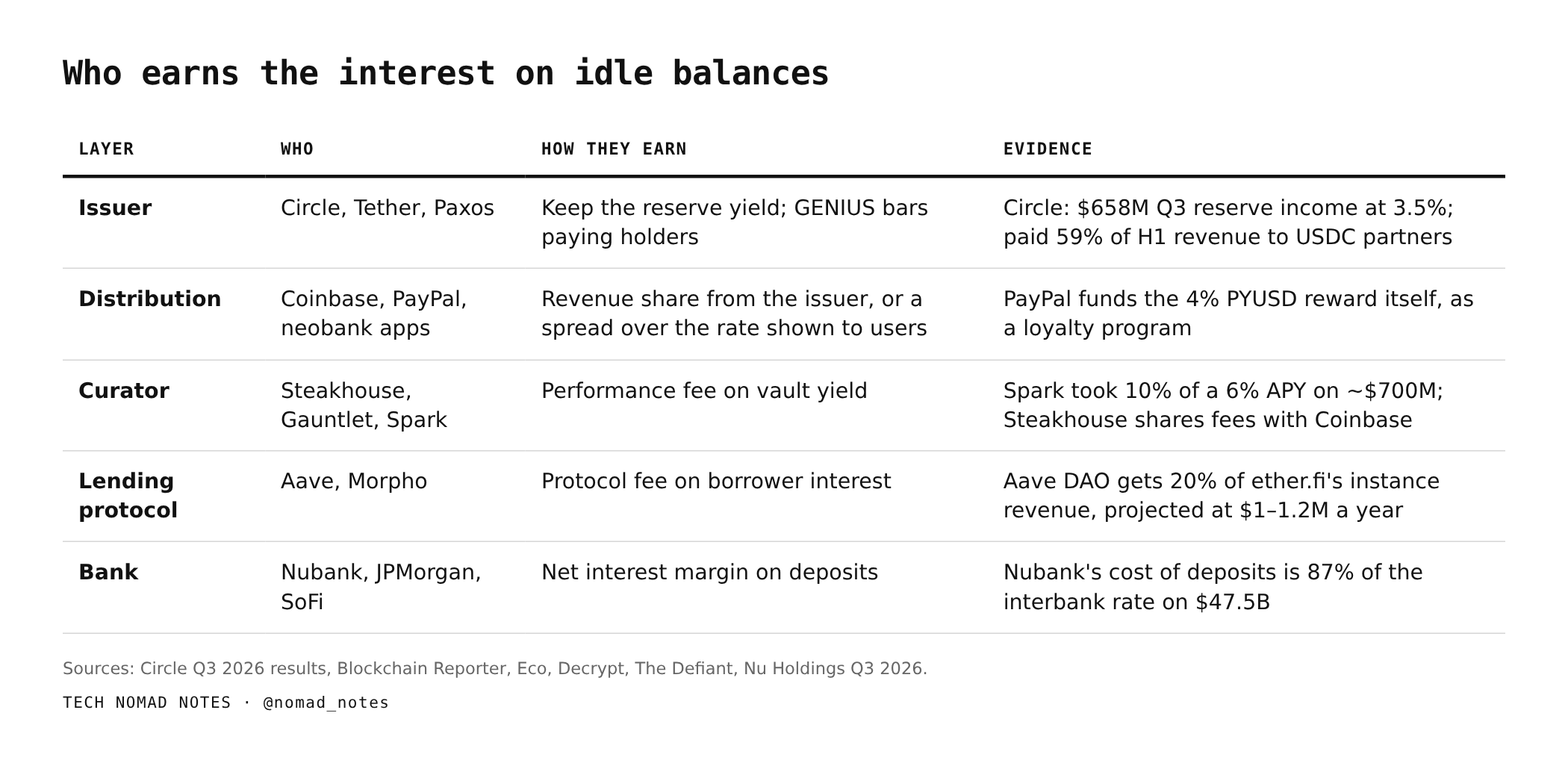
Two things follow.
First, the float is a rate trade. Circle's reserve income fell 8% year over year because its return dropped 61bps, even as average USDC grew 8%. The Fed raised rates in September 2026 to 3.75–4.00% and held in October with two dissents for another hike. Near term, that makes every idle dollar worth more. A cutting cycle reverses it.
Second, the app layer only wins if it owns the user. Circle paying out 59% of H1 revenue to its USDC partners is what distribution leverage looks like. A neobank with 9M customers negotiates that split. A white-label card on someone else's issuer, curator and stablecoin takes whatever is left.
Regulatory map: the yield lane is an option, not an asset
The EU has closed the yield lane. The US has left it ajar until at least the next Congress.
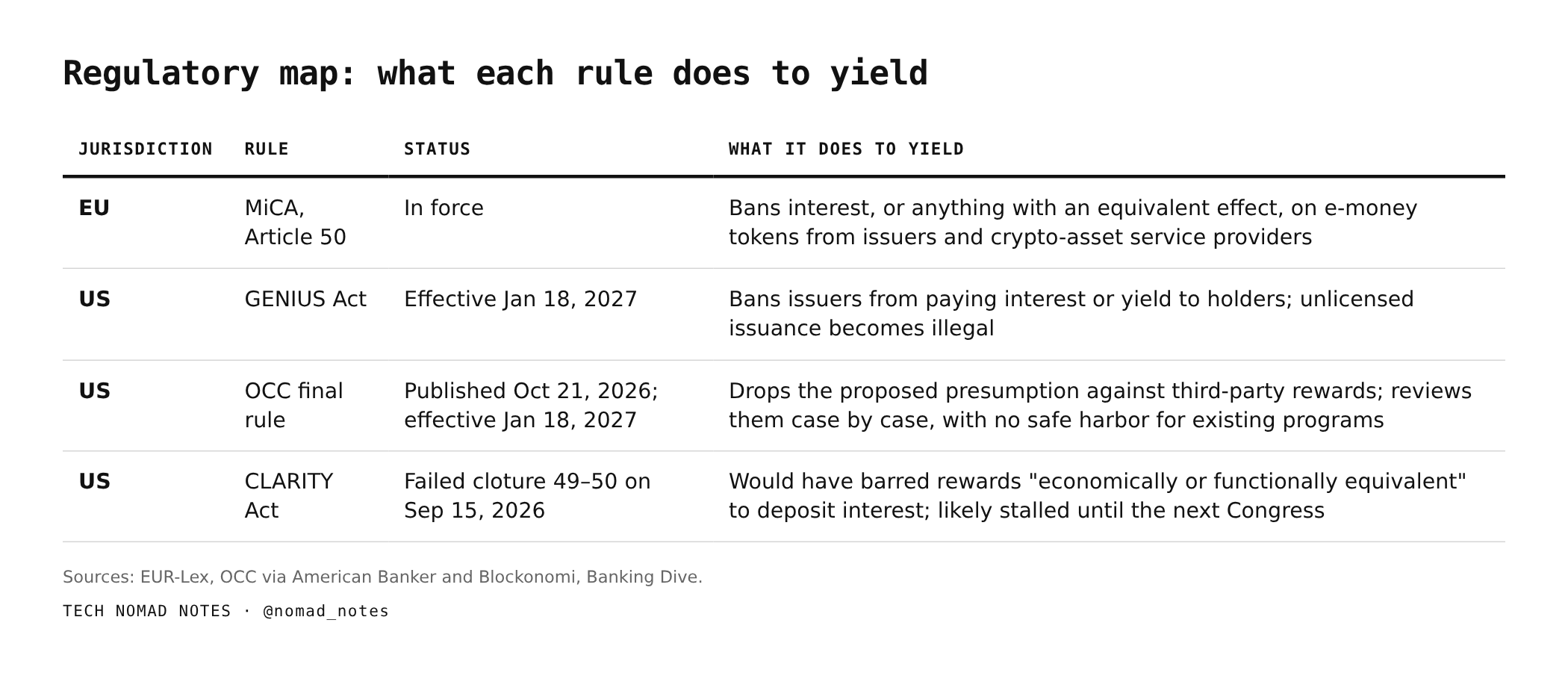
The US lane exists because CLARITY died, not because anyone blessed it. The Senate failed cloture 49–50 on September 15. Community banks fought the rewards language hardest, and a Democratic-drafted bill may give them a more sympathetic ear. The OCC's final rule reviews third-party rewards case by case, with no safe harbor for existing programs, so any one program can lose its rewards by supervisory letter.
Underwrite every US company as if the yield lane closes. If the business only works with 4–9% pass-through yield, it's a regulatory option dressed as a product. If it works on spread, FX and distribution alone, the lane is upside.
Risks and the bear case
The bear case: the float is crypto's own capital cycling, the headline volume is half self-reported, and the yield is a leveraged bet on curators nobody audits. Each risk below has already shown up in the data.
Self-reported volume. RedotPay's August spend of $403.6M is self-reported, about 36% of the headline. Spend actually observed onchain was ~$545M, under half of the $1.116B headline.
The float shrinks with the cycle. Total stablecoin supply fell from $309.7B in May to $288.9B in November, about 7%. The week to November 7 was the steepest weekly drop since Terra in May 2022. Card spend grew through it, but balances are what pay.
Yield blowups are routine. Stream Finance's external manager lost ~$93M and xUSD fell 77%. The vault had grown from $40M to nearly $400M while showing a flat 15% yield. In August a contract drain on Rain-issued programs took $500,859 from 1,685 Avici users and $431,945 from 636 Tria customers.
Swipe economics are negative. ether.fi Cash paid more in cashback than it earned in fees in Q2. Cashback wars are a subsidy race, and the deepest treasury wins it, not the best product.
The tail is already dying. Kulipa halted operations on July 28 after a $6.2M seed. Gnosis Pay volume fell from $12.05M in October 2025 to $8.3M in August. MetaMask Card spend fell 45% between April and August.
Incumbents bring free distribution. SoFi reaches ~15M members in its existing app. Revolut has 75M+ customers. The 21-institution stablecoin anchored by Goldman, BofA and Citi targets H1 2027. None of them needs to buy users with cashback.
Concentration. Rain-settled programs and RedotPay together touch ~78% of tracked card volume. One contract bug, one licence revocation or one sponsor-bank exit moves the whole market.
Rate risk. Circle's reserve return fell from 4.2% to 3.5% in a year. Every 100bps of cuts takes ~$10M a year off each $1B of float.
What would change our mind: onchain-verified spend overtaking self-reported spend, idle balances that hold after promotional yield ends, and one crypto-native winning a full banking licence in a G20 market.
Where we'd invest, and where we'd pass
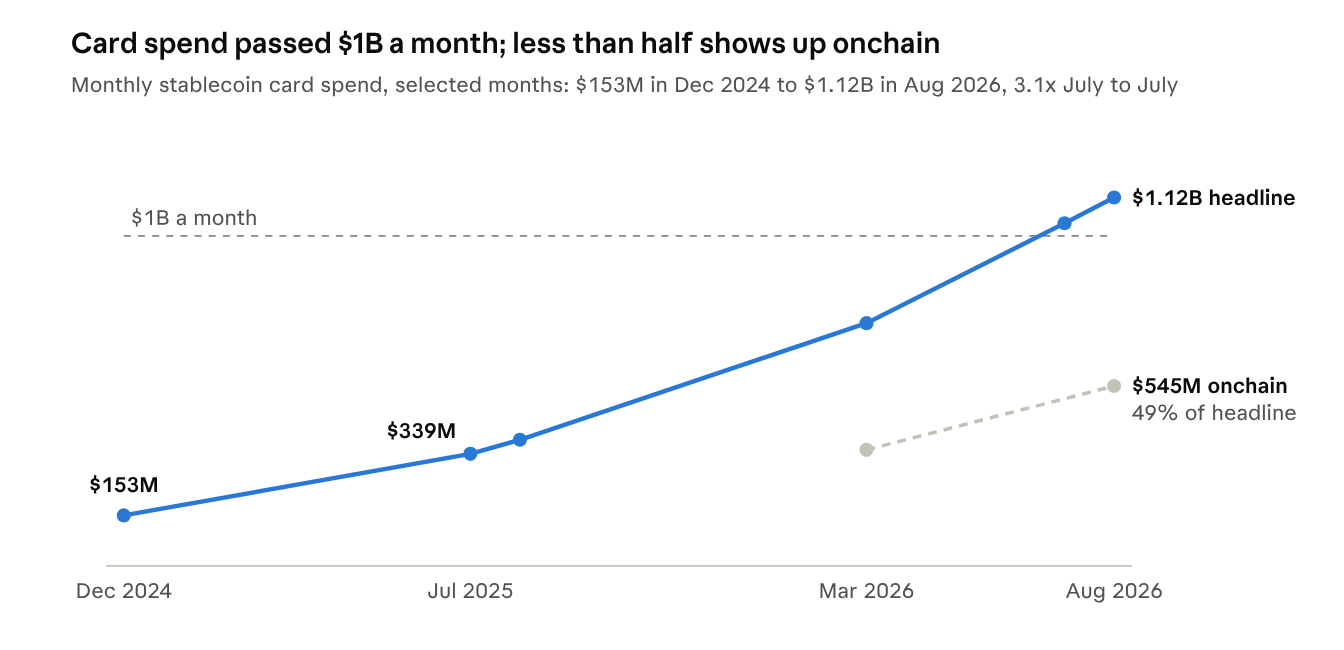
Back the owners of balances and the people who price their risk. Avoid the middle.
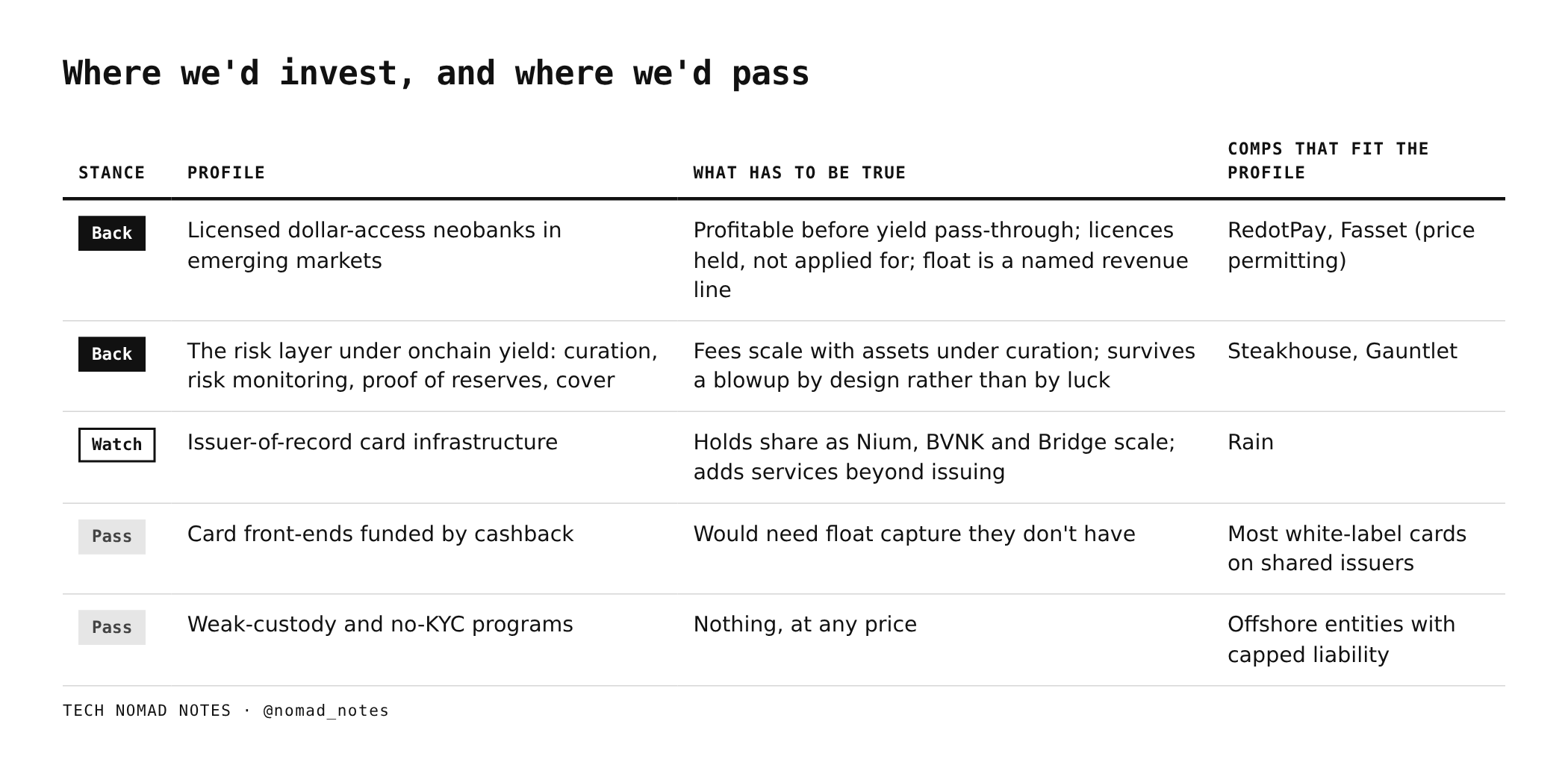
The risk layer is the contrarian call. TradFi entry makes it more valuable, not less. A bank routing USDC into a Morpho vault needs someone to sign off on collateral and liquidation parameters, and the Stream collapse showed what happens when nobody does. Coinbase already routes its users' deposits through Steakhouse-curated vaults.
Diligence questions for any deal in the category
What share of revenue comes from float, interchange and FX, net of cashback?
Is spend verifiable onchain, or self-reported?
What's the average idle balance per user, and how fast does it decay once promotional yield ends?
Who holds legal title to the user's dollar on insolvency, through which entity, in which jurisdiction?
Which licences are held today versus applied for, and what breaks on January 18, 2027?
Which vaults and curators sit under the yield, what's the largest single-collateral exposure, and what are the redemption-gate terms?
What does revenue look like at 100bps lower rates?
What revenue share does the issuer (Circle, Tether, Paxos) pay, and when does that contract reprice?
Sources and disclosure
Independent analysis, not sponsored. Not investment advice. Figures as of November 24, 2026; run-rate and annualized figures are company or tracker extrapolations, not audited totals. Key sources: Defiprime: Crypto Cards 2026, Circle Q3 2026 results, Nu Holdings Q3 2026 results, Sacra: RedotPay, Sacra: Revolut, Cryptorank: Fasset Series C, Morpho: Coinbase case study, crypto.news and CoinGabbar on monthly card spend. RedotPay's ~$2B valuation comes from a single Chaincatcher report, the weakest-sourced number in the comps.