
Every startup raise round gets a press release, but almost never a second public opinion.
This series is your second opinion. Each episode takes one crypto round and runs it like an investment memo: why the company is interesting, why the round happened now, which fund should have led it and didn't, and what would have to be true for it to fail.
No sponsored coverage. No founder quotes as validation. Only onchain data, cap and fee tables - then a view I'm willing to be confronted about in public.
First up: Gauntlet - https://www.gauntlet.xyz/
The deal
Gauntlet, DeFi's third-largest vault curator, raised $125M on July 9 with SBI Holdings as sole investor. Valuation undisclosed, with the Series B 2022 mark sitting at $1B. My read: SBI snagged a seat at the non-dollar onchain credit table, while the crypto insiders who should have led this round have abstained.
The product: Gauntlet curates lending vaults: depositors put stablecoins in, and Gauntlet decides which markets that capital lends into and how much each one can take, sized by its simulation models — basically the risk-parameter work it once did for Aave and Compound, now applied to vaults it runs itself. Deposits sit in non-custodial contracts. Tiers split by appetite: Prime and Core lend against blue-chip collateral, Frontier reaches into higher-yielding markets. Overall, Gauntlet operates more than 70 Morpho vaults across Ethereum, Base, and other EVM chains.
Why this is interesting
The reason this round exists is capital migration in the DeFi lending vertical, i.e., capital leaving pooled lending markets, where governance sets the parameters, and arriving in vaults where a named curator picks the markets, sets the caps, and carries the losses. Curated vault TVL grew roughly 51% year over year to $7.18 billion while overall lending TVL fell 36%.
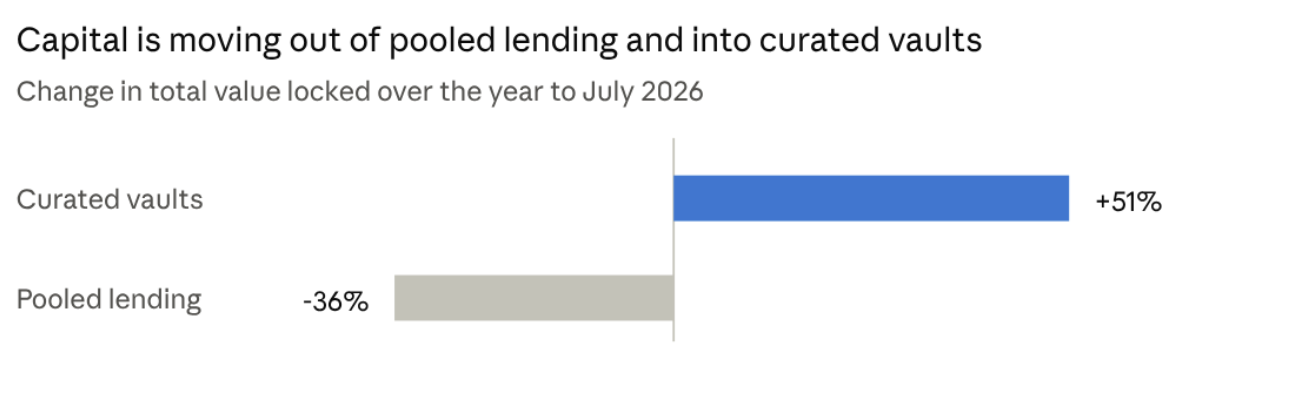
DefiLlama Research, vault economy report · year to July 2026
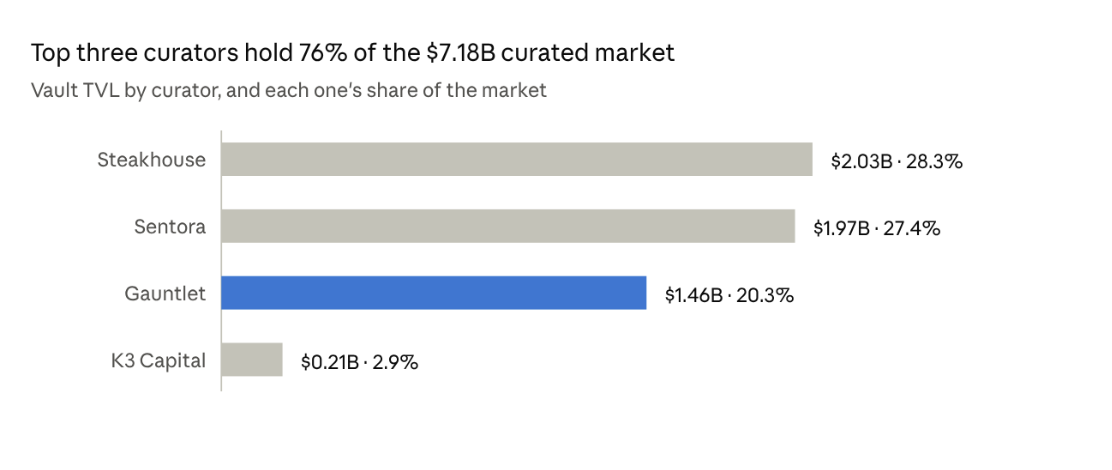
Curated vaults are basically eating the onchain lending market, and Gauntlet holds $1.46B of it, a 20.3% share out of the top-3 onchain curator players. That shift turns risk work from a service contract into a full-blown asset-management business — and the positions should be taken now, not later.
Now look at what the scale earns. Across the top five curators, DefiLlama counted about $13.07 million in fees against $975,600 in retained revenue — the category converts roughly 7.5% of the yield it routes into its own top line. On Morpho specifically, the live dashboard shows $4.47 billion under curation against $13.3 million in annualized curation fees. That makes thirty (!) basis points gross, before the curator hands most of it back to depositors.
Gauntlet's 1.53% looks modest at the very least, but that is a deliberate go-to-market strategy: its vaults carry performance fees between 0% and 20%, and the effective rate says most of the money sits in the zero-fee ones. That's in fact the classic playbook Vanguard used for ETF issuance: price at cost, take the assets, monetize later — through scale, institutional mandates, and products that don't live on a public fee switch. As Tarun Chitra put it, ‘vaults will do to DeFi what ETFs did to equities’.
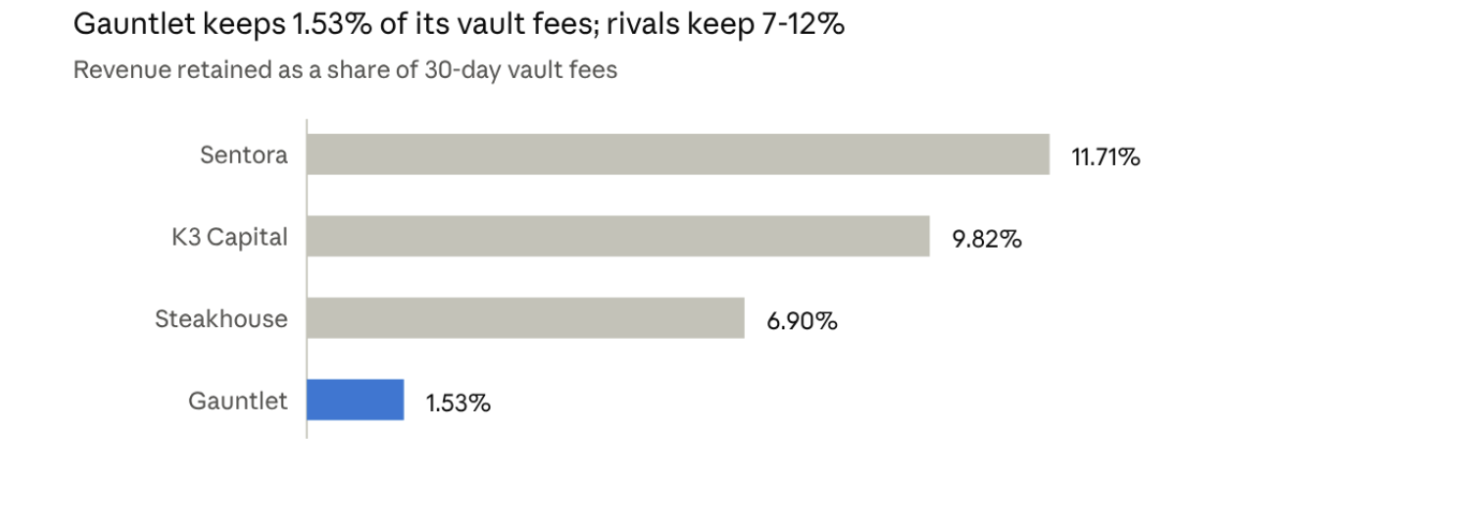
DefiLlama Research · 30-day vault fees and retained revenue, top four curators
Why now
Lending is vaultarizing. Deposits are leaving pooled lending markets for curated vaults, which turns risk work from a service contract into an asset-management seat.
The big US distributors have already chosen a curator.
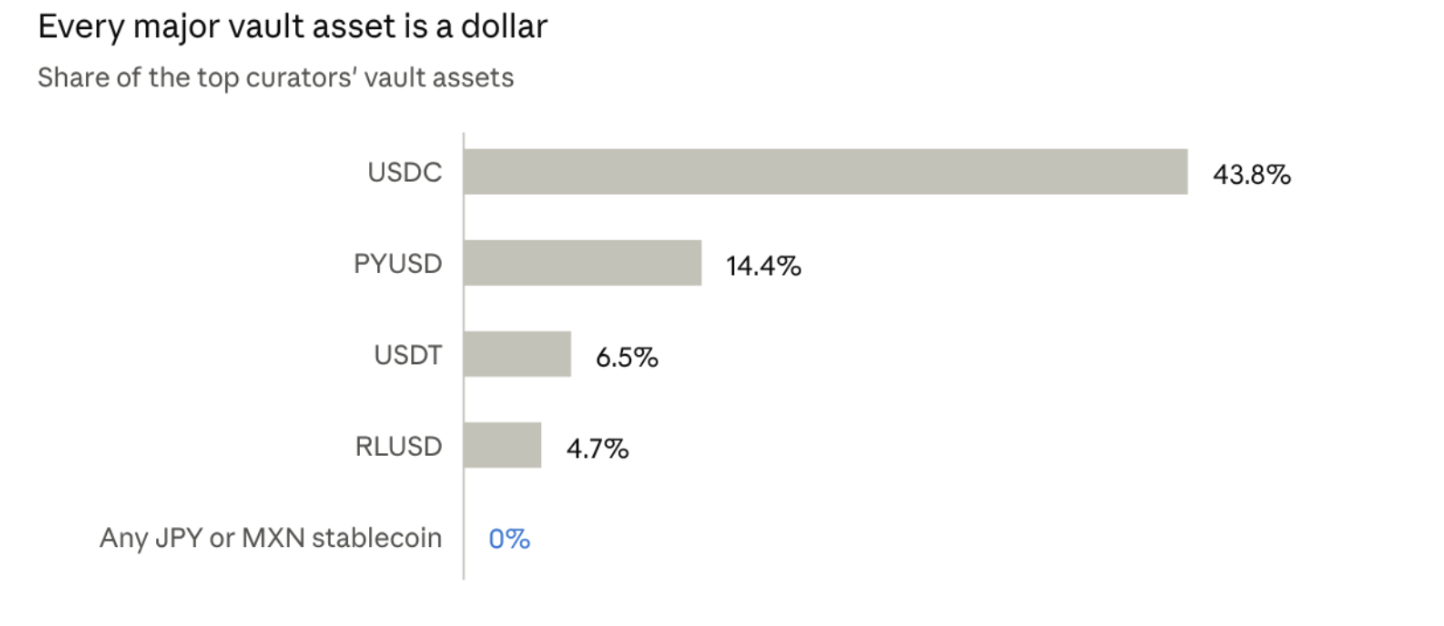
DefiLlama Research · asset mix across the ten largest curators, July 2026
Curation only scales through distribution, and the large US channels are already assigned: Coinbase lets customers lend USDC through Morpho vaults inside its app, Robinhood's Earn product runs through a Steakhouse-curated vault, Kraken's DeFi Earn — past $500 million in deposits — runs on Sentora, and so does Deel's stablecoin rewards programme. Gauntlet has not secured any of those yet, and that reframes the raise: Gauntlet's stated use of funds will expand stablecoin coverage from USD and EUR into MXN, JPY, and other fiat-backed stablecoins, plus infrastructure for traditional capital markets.
Fewer investors are left to price a round. Venture fund participation in crypto rounds slid to 140 in July and 131 in August, while priced lettered rounds went from 13 to 3. When venture funds that usually set a Series C price step back, a corporate investor steps in: SBI also funded EDX Markets' $76M round on its own that same week.
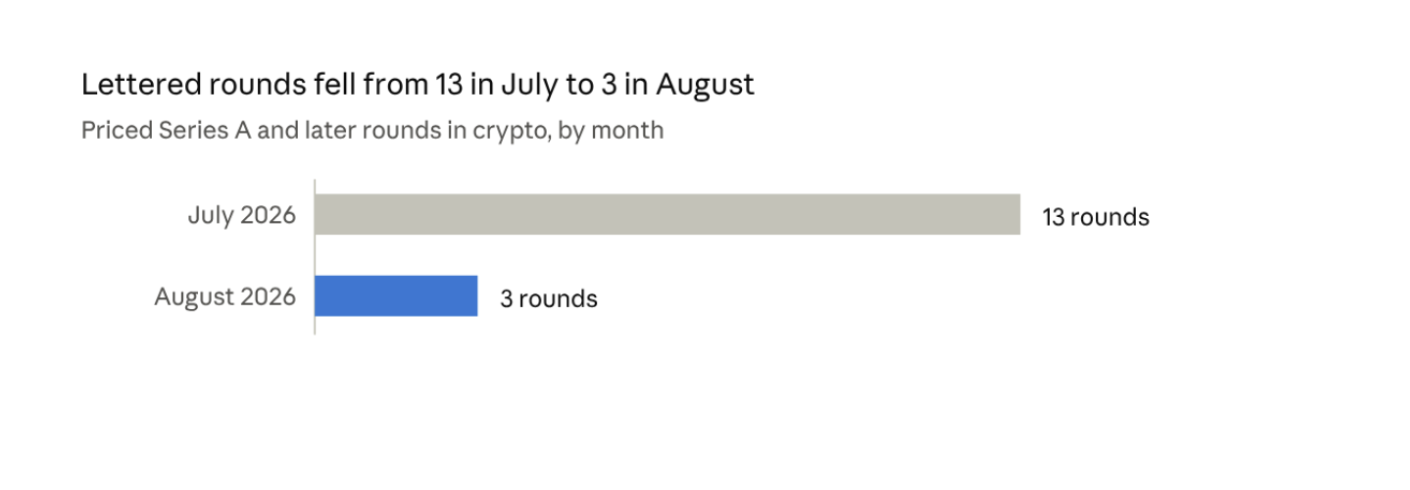
CryptoRank monthly crypto fundraising recaps · July and August 2026
Who could have led this round?
Based on Gauntlet’s cap table and public investment rounds data, Ribbit Capital was most likely to lead this round, as they led Gauntlet's $23.8 million Series B in 2022 at a $1 billion valuation. Four years later, it co-led Morpho's $175 million round with Paradigm and a16z crypto — the rail Gauntlet curates on, with $11 billion in deposits. And its portfolio is the distribution layer the entire vault thesis depends on: Coinbase, Robinhood, Nubank.
Which is what makes their current pass hard to read: either they looked and passed, which is a verdict on Gauntlet's market position, or it was never offered the lead because SBI's balance sheet took the whole round. Paradigm, also a Series B investor and Morpho co-lead, did not participate in this round either.
What would have to be true for this round to fail
The fee take rate never rises. If Gauntlet can't lift fees without bleeding TVL, curation is a permanent customer-acquisition cost and $125 million bought a share, not margin.
SBI's channel doesn't open. The yen stablecoin slips, or SBI's flow lands somewhere other than Gauntlet vaults. Then you own the number-three curator with no captive distributor, plus a strategic on the cap table that makes rival institutions think twice about routing through it.
One vault breaks. The asymmetric one. Curation sells trust, and trust reprices to zero in an afternoon. Stream Finance's $93 million hole in November 2025 cascaded into roughly $285 million of exposure across Euler, Morpho, Silo and Gearbox, with TelosC, Elixir and MEV Capital holding the largest positions. The curators who ate those losses are not the ones at the top of the table today.
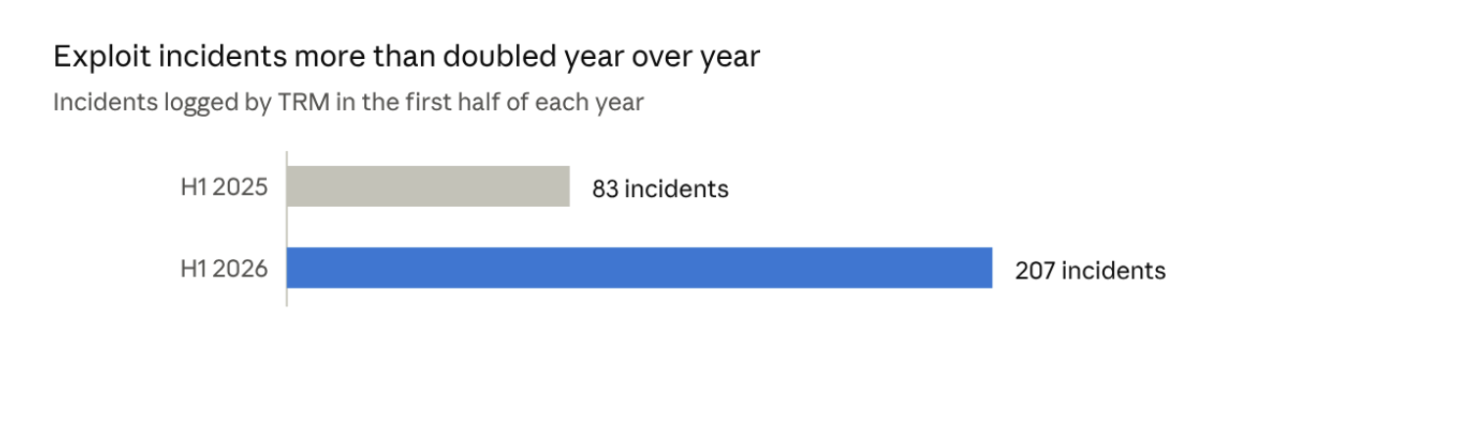
TRM, via DefiLlama Research · first-half exploit incident counts
The US never legislates. SBI's chairman framed the investment around the GENIUS Act and the CLARITY Act. The Senate killed CLARITY in September, leaving the SEC and CFTC to patch the hole with rules a future commission can unwind. If US institutions stay cautious about permissionless vaults, Japan will have to carry out this thesis alone.
What I'm watching for
Gauntlet's own history is the tell here: after four years as Aave's risk steward on a $1.6 million-a-year contract, they finally acknowledged the real business here - capital curation. The pivot was right, the open question is whether the pivot actually has the pricing power. Three things would answer it:
1. Take rate dynamics: any move from 1.53% toward what the rest of the top five curators are capturing.
The uncomfortable implication of a 1.53% take rate is that curation may not be where the margin ends up at all. The fintech owns the customer, the rail owns settlement, and the curator does the hardest job while carrying the bad-debt risk. Gauntlet's $125 million is the bet against that: dollar vaults are a losing game captured by other incumbents at this point, so the money buys a head start in yen and peso vaults, where there is no incumbent to undercut it, and curation can still carry a real fee.
2. Revealing the Japanese distribution partner, ideally announced alongside SBI's stablecoin.
3. The shape of the next funding round: whether a crypto-native fund comes back to price Gauntlet, or SBI keeps writing the whole check.
To me, the base case scenario looks like this: the curation layer keeps consolidating into three or four asset managers who handle the bulk of capital and real distribution, just like the way ETF issuance did, and non-dollar stablecoins will be the last resort for new market entrants. This is where Gauntlet’s bet was right.
But to actually win a seat at this table, Gauntlet will need to pass the litmus test of raising the fee take rate to unlock the real profits: if the current deposits stay in place, with minimal capital exits, their go-to-market was the right bet.
Sources
DefiLlama Research (features rival Sentora)